
If you trade options and have been looking at funded accounts, the rule that decides whether you keep your account or lose it is the drawdown rule. Most traders pay close attention to profit splits and headline payout speeds. Then their account is closed because of a drawdown rule they did not fully understand on day one.
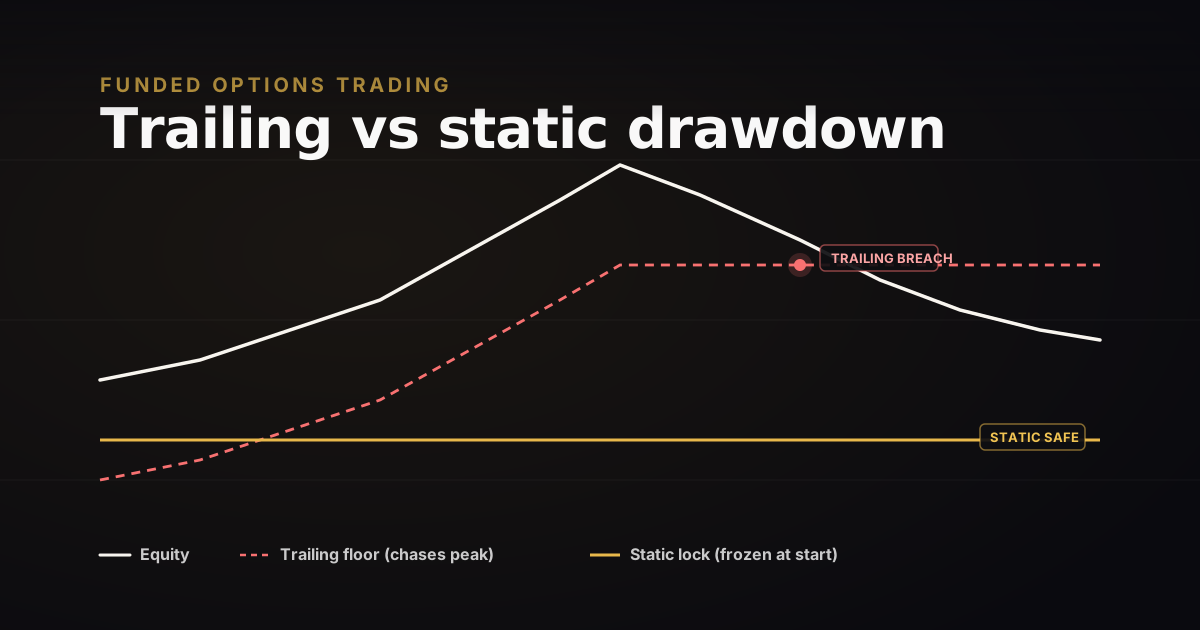
This post explains the two main drawdown models used by funded options prop firms: trailing drawdown, which chases your equity peak, and the static lock, which freezes at your starting balance. Both protect the firm's capital. They protect it in very different ways, and the difference matters most at exactly the moment a profitable trader gives some money back.
What does drawdown mean in a funded account?
Drawdown, in the context of a funded prop firm account, is the maximum amount the trader is allowed to lose before the account is closed. It is the firm's risk control. The firm advances simulated or real capital to the trader, and in exchange, the firm sets a hard line below which the account is dead. If equity touches that line, the trader is done and has to either restart the evaluation or move on.
Every reputable funded options program has a drawdown rule. The question is not whether one exists. The question is how it behaves over time as the trader's equity moves up and down. Two main models dominate the funded-options space, and the gap between them is the single biggest variable in how a profitable trader's account survives the inevitable rough week.
Trailing drawdown explained
Trailing drawdown sets the loss limit as a fixed dollar amount below the trader's highest equity point. As the account gains, the trailing floor moves up to follow it. Once that floor moves up, it does not move back down. Even after a losing day, the floor stays at its highest position.
Worked example. A trader starts a $50,000 account with a $2,500 drawdown allowance. On day one, the floor is at $47,500. The trader gains $3,000 over the next eight days, reaching a peak equity of $53,000. The trailing floor lifts to $50,500. Now the floor is $500 above the starting balance.
If the trader then has a string of losing days and equity drops back to $50,400, the account is breached. Equity is still up $400 from the starting balance, but it is $100 below the trailing floor that the previous peak set. The account closes. The trader is profitable on paper but does not have an account anymore.
This is the most common drawdown model in the funded-options space. It is also the model that catches more profitable traders off-guard than any other rule.
Static lock explained
Static lock means the drawdown floor is set once, at the starting balance minus the allowance, and never moves. It does not chase equity peaks. It does not ratchet up. Whatever the floor is on day one, it is the same floor on day three hundred.
Same worked example, different model. $50,000 account, $2,500 allowance. The floor sits at $47,500 on day one. The trader peaks at $53,000 on day eight. The floor is still at $47,500. The trader gives back $2,600 over the next seven days, landing at $50,400. The floor is still $47,500. Equity is still well above the floor. The account is not breached.
The trader has the same $400 cushion above the starting balance the trailing model produced. But under the static model, the previous peak does not count against the trader. The floor was never lifted, so the floor cannot punish a giveback. This is the structural difference between the two models, and it is most pronounced for the trader who has a profitable run followed by a normal-sized drawdown.
Both models have the same lower limit
One point worth being clear on. The static lock does not give the trader infinite room. The floor is still set at the starting balance minus the allowance. A trader who loses more than the total allowance from the starting balance, in any model, breaches and loses the account. The static lock buys time on the way down from a peak. It does not buy unlimited room on the way down from the starting balance.
See the difference in action
The widget below plays out three trading scenarios on a $50,000 account with a $2,500 drawdown allowance. Pick a scenario and watch the equity line move against the trailing floor (red dashed) and the static lock (gold solid). The "Profitable, then a drawdown" scenario is the closing argument: trailing breaches, static does not.
The interactive widget makes the abstract concrete. A trader who has run an evaluation on paper can plug their own numbers in mentally and see immediately which model would have killed their account on which day. That visceral preview is the value of seeing it run rather than reading about it.
The trader who gains $3,000 and then gives back $2,600 has a 100% breach rate under trailing and a 0% breach rate under static. Same trader. Same scenario. Different account survival.
How each major options prop firm handles drawdown
Different funded options programs use different models. Some use trailing through Evaluation and the same trailing through Funded. Some switch the trailing off when the trader goes Funded and freeze the floor at starting balance. The behavior on Funded is what matters most because that is where real payouts come from.
| Firm | Drawdown model | Behavior on Funded |
|---|---|---|
| Imperial Trader Funding | Trailing | Continues trailing through Funded |
| Maverick Trading | Real capital risk model | Trailing-drawdown concept does not apply |
| Options Funding | Trailing on Evaluation, static on Funded | Locks at starting balance the moment trader goes Funded |
| Trade Fundrr | Real capital risk model (Pro path) | Custom per Pro contract |
| Vanquish Trader | EOD trailing one-way ratchet | Locks at peak equity, never moves down |
Two patterns stand out. Imperial uses standard trailing throughout, which means a profitable Funded trader who has a normal drawdown can lose the account from peak. Options Funding switches behavior at the Funded phase, freezing the floor at starting balance, which gives the trader the entire allowance from the starting balance regardless of how high equity has climbed. Vanquish uses a one-way ratchet that behaves similarly to trailing on the way up but never moves back down, which is closer to trailing than static in practice.
The phrase to look for in a funded program's rules: "drawdown locks at starting balance when funded." If a firm uses that phrase, the static lock is in play. If the rules describe a trailing floor that "follows" or "tracks" equity through the funded phase, trailing is in play, regardless of how forgiving the marketing language sounds.
For comparison, our full 2026 options prop firm comparison covers every rule across all five firms, not just drawdown.
Two models, side by side
Floor follows the peak
Most prop firms
- How it moves
- Tracks the highest equity ever reached. Lifts as equity climbs, never moves back down.
- Profitable trader risk
- High. A normal-sized drawdown after a strong peak can breach even with equity above the starting balance.
- Common scenario that breaks the account
- Strong week, normal pullback. The pullback is bigger than the gap between current equity and the new trailing floor.
- What it rewards
- Traders who reach the profit target quickly, withdraw the gains, and reset their personal high-water mark.
Floor stays at start
Options Funding (Funded phase)
- How it moves
- It does not move. Once set at starting balance minus allowance, it stays there for the life of the account.
- Profitable trader risk
- Lower in the giveback scenario. As long as equity is above the starting balance minus the allowance, the trader is safe.
- Common scenario that breaks the account
- A drawdown that takes equity all the way back to and below the starting-balance minus allowance level.
- What it rewards
- Traders who run the account over weeks and months, allowing equity to swing without losing the account to a peak that has long since passed.
What this means for picking an account
For a trader picking between funded options programs, drawdown behavior on the Funded phase is the rule that matters most over the long run. Profit splits affect the percentage of each payout. Time-to-first-payout affects how quickly that first dollar arrives. Drawdown rules decide whether the account lives long enough to produce a tenth payout.
Profit splits and payout speed compound across many payouts. Drawdown rules decide whether there is a many-payouts to compound across.
Two practical heuristics. First, if the trader's strategy is high-frequency and small wins (like scalping defined-risk verticals), trailing drawdown tracks well because each new high-water mark resets the floor reasonably close to current equity. The trader is rarely far from peak when they take a small loss. Second, if the trader's strategy is occasional larger wins followed by quieter periods (more typical of multi-leg options strategies like calendars or condors), the static lock is the more forgiving rule because it does not punish the trader for normal mean-reversion after a big winning day.
Our public Rules page documents the exact Options Funding drawdown behavior in detail, including the 6% end-of-day trailing on the Growth Plan and the 3% intraday on the Express Plan during Evaluation, plus the static lock that kicks in the moment a trader passes to Funded.
Common questions
What does trailing drawdown actually mean for a funded options trader?
Trailing drawdown means the loss limit moves up as the account hits new equity highs, then stays at that new high even if equity comes back down. A trader who reaches a peak then gives back a portion of it can breach the trailing floor even with equity above the starting balance.
Which is better: trailing drawdown or static lock?
Static lock is more forgiving for the profitable trader who has occasional pullbacks. Trailing drawdown is less forgiving because it punishes a giveback after a peak. Both protect the firm equally well from runaway losses; the difference is how each treats normal trader volatility after a strong run.
Do any funded options prop firms use a static drawdown rule?
Yes. Options Funding switches from trailing during Evaluation to a static lock at starting balance the moment a trader passes to Funded. Most other firms in the options-prop-firm space keep the trailing rule active through Funded, which is the source of most "I was profitable and still lost my account" complaints.
Can a trader breach a static lock?
Yes. A static lock floor is still set at starting balance minus the allowance. A trader who loses more than the full allowance from the starting balance breaches the account under either model. The static lock helps in giveback-from-peak scenarios, not in catastrophic-loss-from-start scenarios.
What is the difference between end-of-day and intraday trailing drawdown?
End-of-day trailing only updates the floor based on closing equity each day. Intraday trailing updates the floor based on the highest equity reached at any moment during the day, which is harsher because intraday spikes that the trader did not close on still raise the floor. End-of-day is more forgiving for traders who hold positions through the close.
Where to verify each firm's drawdown rules
Drawdown rules change. Verify directly on each firm's site before committing to an account:
For the full set of rules side by side, see our 2026 best options prop firms comparison. For the Options Funding specifics, see the Rules page, the FAQ, and How it works.
Get new posts in your inbox
Honest writing on funded options trading and prop firm comparisons. No spam.
Last updated May 16, 2026
← All posts
Join the discussion
Be the first to share your take.